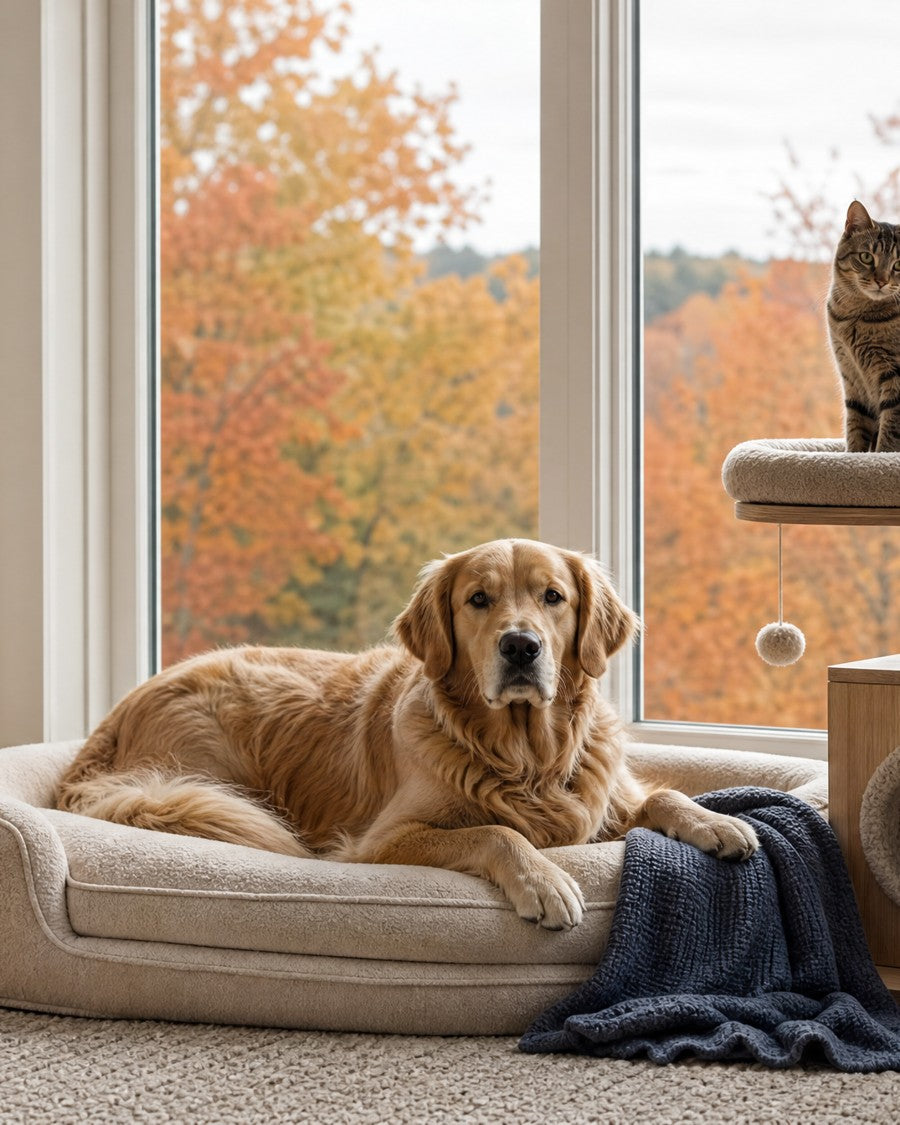
Two cats are wonderful when it works. When it doesn't, you have inappropriate urination, fighting, stress-related illness, and one cat slowly losing weight because the other cat blocks the food bowl. Most multi-cat household problems trace back to the same root cause: insufficient distributed resources. This guide explains the math behind cat resources and how to set up a home that works for two, three, or four cats.
Cats are not pack animals
Dogs are pack animals. They evolved to share resources and follow social hierarchies. Cats are not. Domestic cats evolved from African wildcats - solitary hunters that defended individual territories. Modern indoor cats retain almost all of this wiring. Two cats living in one apartment are essentially two individual hunters being asked to share one territory.
Some pairs of cats genuinely bond - littermates raised together, kittens introduced young, or cats that happen to have compatible personalities. Many cats merely tolerate each other. And some cats actively conflict, even after months or years of living together. The difference is largely about how the home is set up to manage resources, not about whether the cats "like each other."
The single most powerful intervention you can make in a multi-cat household is to provide enough distributed resources that no cat ever has to compete for anything.
The N+1 rule (apply this to everything)
In multi-cat veterinary behaviour literature, the consensus rule is: for any critical resource, provide one per cat plus one extra. This applies to:
· Litter boxes: 2 cats = 3 boxes, 3 cats = 4 boxes, 4 cats = 5 boxes
· Food stations: 2 cats = 3 stations, etc.
· Water sources: 2 cats = 3 sources
· Elevated resting spots: 2 cats = 3 spots (cat tree platforms, windowsills, shelves)
· Scratching posts: 2 cats = 3 posts
This sounds excessive on paper. In practice, it dramatically reduces stress and prevents most multi-cat issues. The reason is competition: if there's only one food bowl, the more dominant cat will claim it, and the subordinate cat will eat less, more anxiously, and develop stress-related health issues.
Placement matters more than count
Three litter boxes side by side in the laundry room count as ONE litter box from the cats' perspective. If a cat is "guarded" from accessing one box by another cat, all three are effectively inaccessible. The rule isn't just "number of boxes" - it's "number of independent locations."
Put litter boxes on different floors and in different rooms. For a 2-cat 2-bedroom apartment: one box in the bathroom, one in the second bedroom, one in a corner of the living area. This makes it physically impossible for one cat to guard all the boxes.
Same principle for food and water. Don't put two food bowls 30 cm apart and call it "two food stations." Put one in the kitchen, one in another room. Cats prefer to eat in private and away from other cats; many subordinate cats only eat when the dominant cat is in another room.
Vertical space is the underrated tool
Cats use the third dimension that humans don't. A 50 m² apartment with no vertical space gives 50 m² of usable territory. Add a tall cat tree, two wall shelves, and a windowsill perch, and you've effectively doubled the available territory - without adding any square footage.
For multi-cat households, vertical space allows cats to physically separate from each other without leaving the room. A subordinate cat on a high shelf is "away" from the dominant cat on the floor in the same way that being in a different room is "away." This dramatically reduces forced interactions.
The minimum vertical setup for a 2-cat home: one tall cat tree (1.5 m+) plus 2 wall shelves placed somewhere else in the home. For 3 cats: add another wall shelf or a second small tree.
Feeding strategy: stop free-feeding
Free-feeding (food always available) seems convenient but creates two problems in multi-cat homes: 1) one cat overeats while the other under-eats, and you don't notice for months because the bowl always looks half-full, and 2) you can't catch early signs of illness (loss of appetite is one of the first signs of many feline diseases - impossible to detect with free-feeding).
Switch to scheduled meals: 2-3 meals per day, each cat eats from their own bowl, in their own location. After 20-30 minutes, pick up whatever isn't eaten. This lets you see exactly how much each cat eats and catch changes in appetite immediately.
For households with one cat that bolts food and another that grazes slowly, microchip-activated feeders solve the problem - each feeder only opens for the assigned cat's microchip. Worthwhile investment if you have a serious feeding mismatch.
Litter box specifics
Multi-cat households have higher litter standards. The fix for most inappropriate urination problems is litter box management:
Scoop daily, minimum. In a 3-box, 2-cat home, that's a few minutes per day.
Full litter change every 1-2 weeks. Dump all litter, wash the box with mild soap, refill with fresh litter. More frequently if you have a finicky cat.
Box size: bigger is better. Most commercial cat litter boxes are too small for adult cats. The interior should be 1.5x the length of your cat (nose to base of tail). Storage bins from hardware stores often work better than dedicated cat litter boxes.
Open vs. covered. Most cats prefer open boxes. Covered boxes trap odour inside (the cat is fine with the smell, but humans aren't). For shy cats in a multi-cat home, a covered box does provide privacy. Test both.
Litter type: low-dust unscented clumping litter is the safest default. Scented litters can deter sensitive cats. If one of your cats stops using the box after a litter change, switch back immediately.
Introducing a new cat to an existing cat
This is the most common multi-cat failure point. People bring home a new cat, put both cats in the same room, and hope for the best. Result: aggression, hiding, stress-related illness, and often a permanent failure of the relationship.
The proper introduction takes 2-4 weeks:
Week 1: separate rooms. New cat in their own room with all resources (litter, food, water, bed). No visual contact yet. They can smell each other under the door.
Week 2: scent swap. Swap blankets, pet beds, and toys between the rooms. Each cat gets used to the other's smell on neutral objects.
Week 3: visual contact. Open the door a crack (or use a baby gate) so they can see each other but can't get to each other. Feed them on opposite sides of the gate so they associate the other cat with mealtime.
Week 4: supervised contact. Brief, supervised meetings in a neutral room. Increase duration if it's going well. Separate at the first sign of conflict.
This is slow and tedious. It also dramatically reduces the rate of permanent conflict between adult cats.
Warning signs of multi-cat stress
Watch for these signs that the resource setup isn't working:
· One cat hiding for long periods
· Eating less or losing weight (especially the subordinate cat)
· Urinating outside the litter box (often the first visible sign of multi-cat stress)
· Excessive grooming (especially belly licking until the fur is thin)
· Spraying (vertical urine marks on walls or furniture)
· Aggression at specific times (around food, near litter boxes, in narrow doorways)
· New or worsening medical issues (urinary tract issues are especially stress-linked)
If you see two or more of these, your resource distribution probably needs work. Add more litter boxes (in different rooms), add more feeding stations, add vertical space. This solves most cases. If it doesn't, talk to your vet - some multi-cat conflicts are medical and some need behavioural intervention.
Our picks: cat resources from petcarestore.ca
For a typical 2-cat Canadian household, the must-haves are: at least one quality cat tree, multiple water sources, and one good carrier for each cat. We recommend:
· Multi-level cat tree with condo and hammock for vertical space
· 2 L silent water fountain as one of your N+1 water sources
· Catnip rope toys for individual play - reduces inter-cat boredom-driven conflict
Browse the full cat supplies collection for everything else you need to set up a peaceful multi-cat home.
Frequently Asked Questions
How many litter boxes do I need for two cats?
Three boxes minimum, placed in different rooms or different floors. Two boxes side by side count as one box from the cats' perspective. The N+1 rule is the consensus standard.
Can two cats share one food bowl?
They can, but often shouldn't. One cat usually dominates the bowl, leading to over-eating by one and under-eating by the other. Separate feeding stations in different rooms prevent this.
How long does it take two cats to get along?
With a proper 2-4 week gradual introduction, most cats reach peaceful coexistence within 1-3 months. Some bond closely; many merely tolerate each other (which is fine).
My cats fight at the door - what do I do?
Narrow doorways are choke points. Subordinate cats get cornered by dominant cats here. Add furniture or cat shelves that let the subordinate cat pass over or around the dominant cat.
Should I get one cat or two from the start?
Two kittens from the same litter, raised together, almost always do better than adopting two adults separately. Adopting a bonded pair skips most of the introduction work.
Why is my cat peeing outside the litter box?
Multi-cat household problem 90% of the time. Usually: not enough boxes, boxes too close together, boxes too dirty, or one cat blocking access. Vet check first to rule out medical.
Also searched as: multi-cat household Canada, how many litter boxes for two cats, multi-cat feeding stations, cat resources, cats fighting in same house