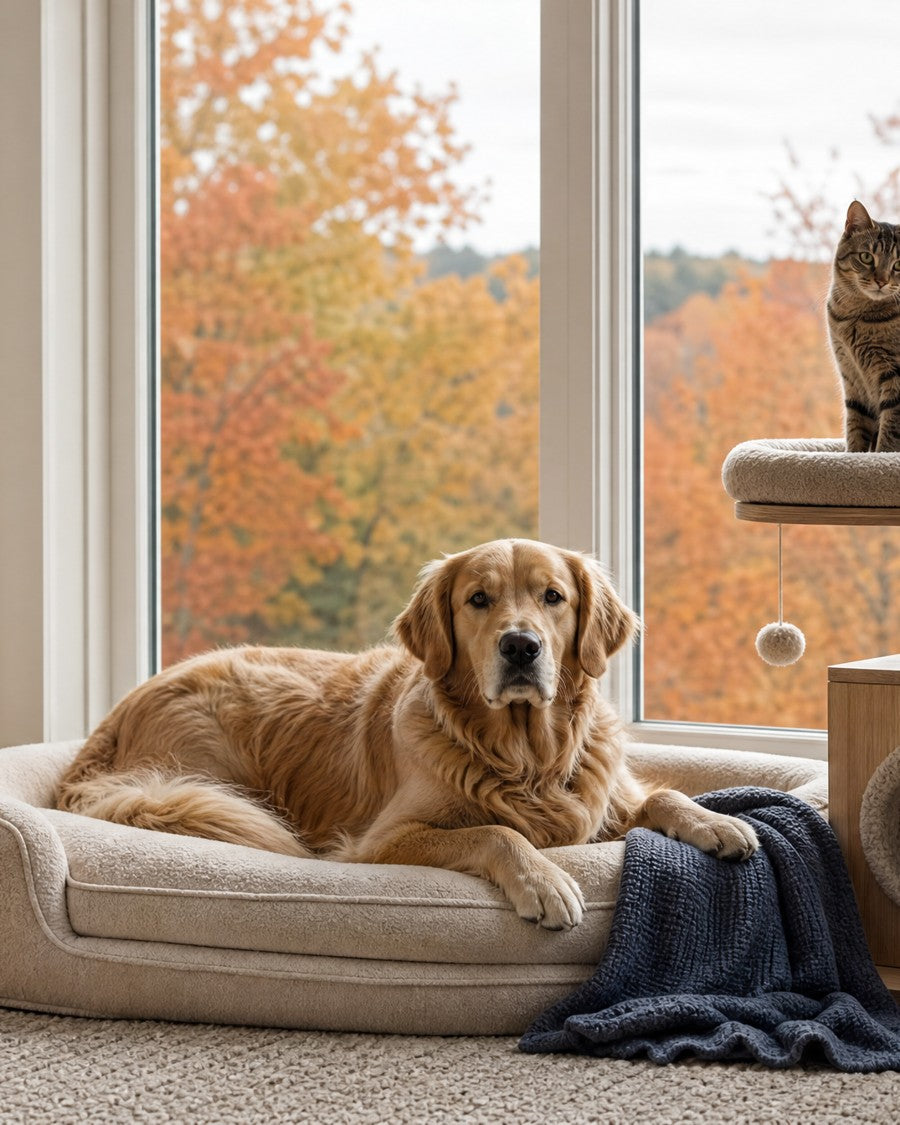
Dog bed sizing seems obvious until you actually buy one. Small, medium, large, XL — the labels mean different things on different brands. A "large" bed from one manufacturer is a "medium" from another. After you've returned two beds (and paid for return shipping), you'll wish you'd just measured your dog. Here's how to do it once, and how to size up the way the dog actually wants.
Why most dog beds don't actually fit
Dogs sleep in three positions: curled, sprawled, and stretched. Different breeds and individual dogs default to different positions, and the bed needs to accommodate the largest position your dog uses. A bed sized for the curled position will work for naps but be too small for night sleep, when your dog will likely stretch out. Many Canadian dogs end up sleeping off their bed (head on the edge, body on the floor) because the bed isn't big enough for stretch sleep.
The other half of the problem is that manufacturer sizing charts are inconsistent. "Large" can mean 70 cm or 110 cm depending on brand. The only way to be confident is to measure your dog and match the dimensions in centimeters or inches, not the size label.
Measuring your dog (it takes two minutes)
Wait until your dog is sleeping in their most stretched-out position (usually evening). Then measure:
Length: nose to base of tail (not tip). For most dogs this is the longer dimension.
Width: across the widest part of their lying body, usually across the shoulders or hips.
For accurate readings, use a soft tape measure or even a piece of string you mark and then measure against a ruler. If your dog won't lie still, do it in stages while they're distracted with a chew.
Write both numbers down. These are your minimum bed interior dimensions — you'll add to them in the next section.
The +20% rule
Take your dog's length and width and add 20% to each. That's the minimum bed dimension your dog will actually use comfortably. The extra 20% gives them room to stretch and shift without falling off, and accommodates the curled sleep position which actually needs more diagonal space than the stretched position.
Example: a 80 cm long, 50 cm wide Labrador needs at least a 96 cm by 60 cm bed. The next standard size up (usually 100 x 70 cm) is the right pick.
For puppies that are still growing, size for adult dimensions (look up the breed average) so you're not buying a second bed in six months. For senior dogs, add another 10% on top of the 20% — older dogs stretch out more when joints stiffen, and they need room to shift without effort.
Sleep style: curler vs sprawler
Curlers are dogs that sleep in a ball, nose tucked. Most small breeds (Pomeranians, Chihuahuas, Yorkies) curl by default. Some larger breeds also curl — Greyhounds, despite being long, often curl when sleeping. Curlers prefer round or oval beds with raised bolsters. The bolster gives them something to rest their head on and creates a sense of enclosure.
Sprawlers are dogs that lie flat on their side or back, legs extended. Labrador Retrievers, German Shepherds, and most working breeds sprawl. They need rectangular flat beds with no bolsters or with low bolsters they can hang their head over.
Both dogs — most actually switch between styles — need a rectangular bed with a low or partial bolster that doesn't restrict stretching.
Bed type: bolster, flat, donut, or orthopedic?
Flat mat: Cheapest. Good for cratesleeping or crating. Limited support — doesn't last long for dogs over 15 kg.
Bolster bed: Walls on three sides, open on one. Most popular shape. Good for small-medium dogs that like a head rest.
Donut/round: Bolster all the way around. Best for curlers and anxious dogs — the enclosure feels secure.
Orthopedic: Memory foam or supportive foam base. Essential for dogs over 7 years, dogs with hip dysplasia, arthritis, or recovering from surgery. Also recommended preventively for large breeds (Labradors, Goldens, Shepherds, anything over 25 kg) from age 5.
Cooling mat: Self-cooling gel pad. Useful in summer for thick-coated breeds or in homes without air conditioning. Not a primary bed — it's a layer on top of a regular bed.
Mistake 1: buying for the puppy size
You bring home a Labrador puppy. You buy a medium bed. Six months later, your "medium" dog is now 30 kg and has outgrown the bed. You buy a large bed. Twelve months later your dog is 35 kg and outgrown that. Either commit to buying multiple beds, or buy adult-size from the start and use a folded blanket in it while the puppy is small.
Mistake 2: matching the bed to the crate, not the dog
Crate manufacturers sell mats sized to the crate floor. Crate sizing is based on the dog standing up and turning around, with about 15–20 cm of extra length. A bed sized to the crate exactly will fit, but won't have stretch room. Either size up your crate, or accept that the crate bed is a sleeping mat (not a lounge bed) and provide a real bed outside the crate.
Mistake 3: ignoring the cover
A non-washable bed cover is a 3-month bed. Dirt, drool, and dander build up fast. Look for: removable, machine-washable outer cover, plus a waterproof inner liner under the foam. Without the waterproof layer, any accident or spilled water destroys the foam permanently.
Zippers should be hidden or covered by a flap (exposed zippers can scrape the dog's face when they rest their head). Stitching should be reinforced — the seams are the first thing to fail.
Bed dimensions by breed size (rough guide)
If you can't measure your dog right now, here's a starting point. Adjust based on the +20% rule once you measure:
Toy breeds (Chihuahua, Yorkie, under 5 kg): 55 x 40 cm
Small breeds (Beagle, Cocker, 5–15 kg): 75 x 55 cm
Medium breeds (Border Collie, Bulldog, 15–25 kg): 90 x 65 cm
Large breeds (Labrador, Golden, German Shepherd, 25–40 kg): 110 x 75 cm
Giant breeds (Great Dane, Newfoundland, over 40 kg): 130 x 90 cm
Deep-chested or long breeds (Greyhound, Wolfhound, Boxer) need longer beds — add 10–15 cm to the length for these.
Bed location: where to put it in your home
Even the right bed in the wrong place will be ignored. Three placement principles:
Where your dog already sleeps. Notice the corner, room, or hallway your dog already naps in. Place the new bed there. Don't try to relocate your dog — let the dog tell you where they want the bed.
Away from drafts and direct sun. Beds near doors get hit by cold drafts in winter, and direct sun makes the bed surface uncomfortably warm in summer. Aim for a quiet interior corner.
Within sight of family activity. Most dogs are social. A bed in the basement laundry room won't get used if the family is upstairs. Put the bed in or adjacent to the living room so your dog can rest near you without being underfoot.
For multi-dog households, give each dog their own bed. Cohabiting dogs may sometimes share, but they should always have the option to sleep separately. Forced sharing is a low-grade stressor that adds up over months.
Our pick: Memory Foam XL Orthopedic Dog Bed
The Eheyciga Memory Foam XL Orthopedic Dog Bed covers most large and giant breeds with a 110+ cm interior, has the removable washable cover with waterproof liner, and uses real memory foam (not the cheap polyester batting that compresses in six months). It ships from Canada in CAD pricing. For smaller breeds, browse the full dog bed collection — we carry every shape and size from toy bolster beds to giant orthopedic mats.
Frequently Asked Questions
Should I buy a bigger bed for a growing puppy?
Yes — buy the size your dog will be as an adult and use a folded blanket inside the bed to keep it cozy while they're small. Buying multiple beds as they grow gets expensive.
Are orthopedic beds worth the extra money?
For dogs over 7, dogs of large breeds prone to joint issues, dogs recovering from surgery, or any dog with arthritis — absolutely yes. For young small breeds, a regular bolster bed is fine.
How often should I replace my dog's bed?
Every 2–4 years for quality memory foam beds, every 1–2 years for poly-fill beds. Replace sooner if you notice flat spots, unpleasant odour that survives washing, or if your dog starts sleeping next to the bed instead of on it.
Can I machine-wash my dog's bed?
Only if the manufacturer says so. Most beds have a removable washable cover but a non-washable foam interior. Washing a foam interior typically destroys it. Wash covers in cold water on gentle cycle and air-dry.
My dog won't use a new bed. What do I do?
Place it in the spot they already sleep in. Add a piece of clothing that smells like you. Don't force them onto it — let them choose. Most dogs adopt a new bed within a week. If they're still avoiding it after two weeks, the bed may be the wrong size or texture for them.
Why does my dog sleep on the floor instead of their bed?
Three usual reasons: bed is too small (most common), bed is too hot (especially in summer for thick-coated breeds), or bed location doesn't suit them (too noisy, too far from family). Try moving it before assuming the bed itself is wrong.
Eheyciga Memory Foam XL Bed · All dog beds · Senior & wellness products
Also searched as: dog bed sizing Canada, what size dog bed, dog bed for large breed Canada, orthopedic dog bed size, measure dog for bed