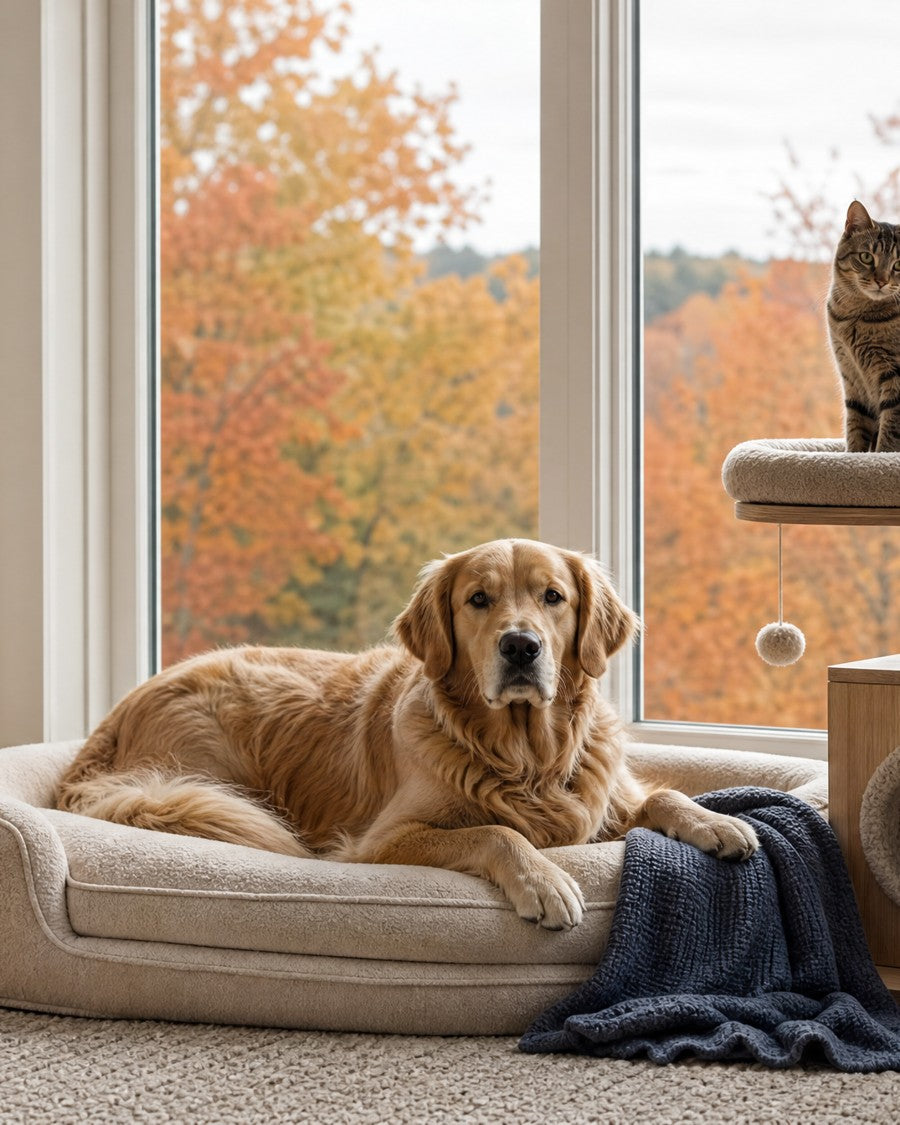
A good cat tree gives a single indoor cat ten extra cubic meters of usable space — vertical space they otherwise wouldn't have. A bad one is a tippy eyesore that ends up in the basement. The difference is rarely price — it's matching the tree to your cat, your apartment, and how your cat actually behaves. This guide breaks down towers, condos, and wall-mounted setups, with sizing for typical Canadian condo footprints.
Why vertical space matters for indoor cats
Cats are natural climbers and observers. In the wild, a cat spends a substantial portion of waking time at elevation — in trees, on rocks, on shed roofs. This isn't just for hunting; it's a stress-management strategy. Being high up means safer from predators, better sightlines, and more control. Indoor cats with no vertical access often develop redirected anxiety: scratching furniture, over-grooming, urinating outside the litter box, or aggression toward other cats in the home.
Adding 1–2 meters of vertical space — via a cat tree, wall shelves, or a tall scratching post — meaningfully reduces these behaviours in most cats. A 2018 University of California review found vertical access reduced stress markers in indoor cats by 30–40% across multi-cat households.
Tower vs. condo vs. wall-mounted: pick the right shape
Towers are tall, narrow vertical structures, usually 120–180 cm tall. They have multiple platforms stacked vertically with scratching posts between. Best for small apartments — they use floor space of roughly 50 x 50 cm but give 1.5 meters of vertical territory. Most popular shape for one cat.
Condos are wider, lower structures with one or more enclosed cubbies and a couple of platforms. Usually 80–120 cm tall, 60–80 cm wide. Best for shy cats and multi-cat homes — the enclosed cubbies provide safe nap spots out of sight of other cats or family members. Slightly bigger footprint but more usable surfaces.
Wall-mounted shelves are individual platforms attached directly to a wall via studs or anchors. They save floor space entirely and can run anywhere — up walls, around corners, over doorways. Best for renters with permission (they need anchor holes) and for permanent residences where you can commit. Combine with a single cat tree for the best of both.
Sizing for typical Canadian condo footprints
Most Canadian condos have a 50–80 m² main living space. Here's what fits:
Studio or 1BR under 50 m²: one tall, narrow tower (160 cm height, 45 x 45 cm base). Place in a corner near a window. Add 1–2 wall-mounted shelves if the cat needs more.
1BR or 2BR 50–75 m²: one medium tower or one condo. If two cats, get both — place in different rooms so they each have a territory.
2BR+ 75 m²+: one tall multi-level cat tree (170+ cm) in the main living space. For two or three cats, add a smaller second tree or wall shelves in another room.
Height matters more than footprint. A 1.7 m tower gives more usable territory than a 1.2 m condo even though they take the same floor space.
Materials: what to look for
Sisal rope on scratching posts. The standard. Sisal lasts 1–3 years of heavy scratching. Avoid carpet-wrapped posts — they teach your cat that carpet is an acceptable scratch surface, which is the opposite of what you want.
Faux fur or short-pile fabric on platforms. Soft, washable (some have removable covers), and the texture cats prefer for napping. Plush fur looks luxurious but sheds and is hard to vacuum.
Particle board or solid wood frame. Solid wood lasts longer and resists wobble, but adds weight and price. Particle board is fine for one or two cats but degrades faster, especially at the joints. Look for 25 mm+ thick particle board if you go that route.
Anti-tip strap or wall anchor. Critical for any tree over 1.2 meters. Cats jumping off the top can tip a non-anchored tree, especially if there's a heavier cat. A simple strap that screws into a wall stud solves this in 10 minutes.
The number-one buying mistake: undersized base
The most common cat tree return reason in Canada is wobble. The fix is almost always a wider base than manufacturers default to. As a rule, the base should be at least one-third the tree's height in width. A 160 cm tree needs at least a 55 cm base. Anything narrower wobbles when a cat leaps to the top, and a wobbling tree teaches your cat to avoid it.
If you've already bought one with a narrow base, you can either anchor it to a wall (preferred) or place a rubber furniture mat under it for grip. Don't try to weight the base — that doesn't fix the geometry problem.
Placement: where to put the cat tree
Three placement rules:
Near a window. The single best location for a cat tree is overlooking a window with bird activity. Many cats use the top platform as a primary observation spot — you'll see 4–8 hours a day of use if the window has activity outside.
Not in a high-traffic zone. Don't put it next to the front door, the kitchen main path, or anywhere people walk past every few minutes. Cats want elevation and calm.
Not against the radiator or vent. Cats love warm spots, but pressing the tree against a radiator dries the wood and faux fur over time. Keep at least 30 cm of clearance.
Multi-cat households: territory and resources
In a two-cat home, one cat tree may cause conflict — the higher-ranking cat claims the top, and the subordinate cat avoids the tree entirely. The fix is either two trees (in different rooms) or one tree with multiple platforms at similar heights so neither cat "owns" the top.
For three or more cats, plan one observation spot per cat, plus one extra. This doesn't have to be three cat trees — a single tree with three platforms plus one wall shelf works. The principle is that no cat should be forced to share a single elevated spot with another cat they don't get along with.
How long a cat tree lasts
A quality cat tree lasts 4–7 years before needing replacement. Failure points in order:
· Sisal rope wears down (replaceable on some trees, replace whole post on cheaper ones) — 1–3 years
· Faux fur compresses and loses softness — 3–5 years
· Particle board joints loosen — 4–7 years
· Solid wood frame indefinitely
Vacuum the tree weekly to extend life. Spot-clean spills immediately — the fur absorbs liquids fast.
Assembly tips and breaking-in your cat
Most cat trees ship flat-pack with all hardware included. Two pieces of advice that save hours of frustration:
Lay out all the hardware before starting. Premium trees ship with 30–50 screws and bolts of varying lengths. Sort them by size before you begin. Lost or mixed-up hardware is the most common complaint in cat tree reviews.
Tighten everything twice. Wood compresses slightly after the first tightening. Go through all bolts again after 24–48 hours of cat use — you'll be surprised how much each one needs another quarter turn. This stops the wobble that develops with use.
To get your cat interested in the new tree, rub a small amount of catnip on the platforms (especially the top one). Hide treats on each platform for the first few days. Place toys at different levels. Most cats investigate within 24 hours; some take a week. Don't lift your cat onto the tree — let them claim it on their own terms.
For shy cats, place a familiar blanket or your worn t-shirt on one of the platforms. The familiar smell encourages them to investigate. Within 2–3 days most will start using the tree as a primary nap spot.
Our picks: cat trees from petcarestore.ca
The Gitelsnour Multi-Level Cat Tree with Condo, Baskets and Hammock covers most one or two-cat Canadian apartments. It's tall (160 cm), has a wide stable base, multiple sisal posts, a covered condo for shy cats, and a top perch for window-watchers. Anchor strap included. For smaller apartments or kittens, browse the full cat tree collection.
Frequently Asked Questions
How tall should a cat tree be?
Minimum 1.2 meters for adult cats. Ideal range is 1.5–1.8 meters. Taller is generally better because cats want to be high up — but keep at least 30–40 cm of ceiling clearance so they don't bump their heads when jumping to the top.
Will my cat actually use a cat tree?
About 85% of cats use a cat tree within a week if it's placed in the right spot (near a window, away from traffic). The other 15% need encouragement — sprinkle a tiny bit of catnip on the platforms, place treats on each level for a few days, or move it to a different location.
Do I need to anchor a cat tree to the wall?
For trees over 1.2 meters, yes. Most quality trees include an anchor strap that screws into a wall stud. This is a 5-minute install that prevents tipping if a heavier cat jumps off the top platform.
Sisal or carpet for the scratching post?
Always sisal. Carpet-wrapped posts teach your cat that carpet is an acceptable scratching surface — including your apartment's carpet. Sisal has a distinct texture that cats easily separate from household textiles.
Cat tree vs. wall-mounted shelves — which is better?
Both have a role. Cat trees are easier to install and provide a stable observation spot. Wall shelves save floor space and create longer climbing paths. The ideal setup combines a single cat tree near a window with 2–3 wall shelves nearby.
How often should I replace a cat tree?
When the sisal is fully worn through, when the structure becomes wobbly, or when your cat stops using it — whichever comes first. Most quality trees last 4–7 years. Some parts (sisal posts) can be replaced individually if the rest of the tree is still solid.
Also searched as: cat tree Canada, cat tree small apartment, cat condo vs cat tree, wall mounted cat tree Canada, tall cat tree